Wednesday, March 31, 2021

A case study in the fruits of secular "scholarship"

I recently got my first major hater, and you may know this if you saw my recent posts on Facebook and Gab. This wasn't a mere "ur wrong bigot" or some other innocuous trash comment. It was actually two comments at a near essay length on my video response to the TikTok lady theologian, from an alleged religious studies academic in South Africa by the name of Tristan Kapp. I Googled him out of curiosity and he seems to actually have a degree of fame...

... as a "Reverend" in the South African Satanic Church [I], with a Master in Divinity.

...

...

*WHEEZE*

Not kidding, just read the interview in footnote I.

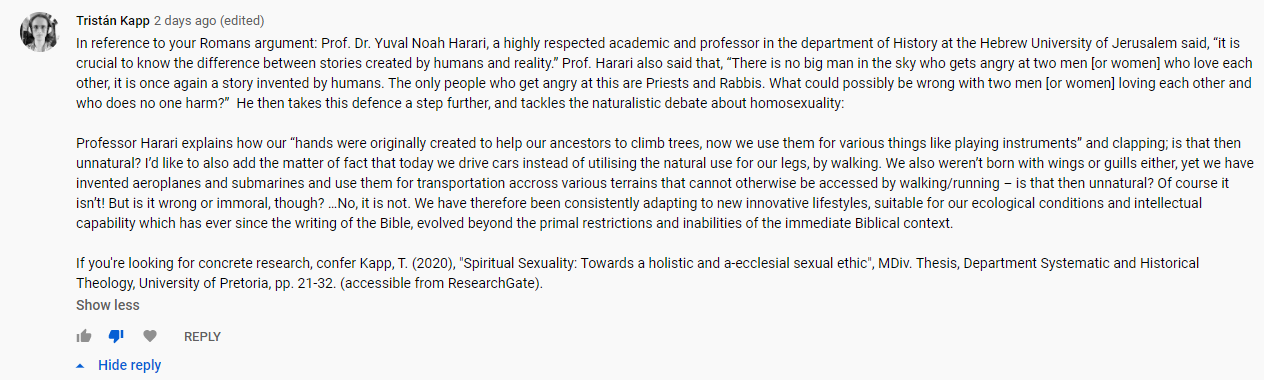
Here is his first comment:


I of course responded with a miniature essay [II].

And this is his second comment:


And likewise my reply [III].

Take a minute to massage your face after it scrunched from all that cringe.

Now, I hope people can see how at least his second comment is utterly stupid (the first requires some specialised knowledge to see how he's wrong), and the sheer scale of his fallacies baffled me. But when I found out his position as a Satanic "Reverend", the pseudo-scholarship of his comments suddenly made sense. When you adopt man-centred ideals (an adjective his religion will happily accept) and want to see them flourish, it's very attractive when you see a section of biblical scholarship argue that such values are promoted (or at least not contradicted) in the scriptures; you could turn the foundations of Christians against them. Or, when they are too clear in their condemnation of modern activities, we just need to ridicule them with infantile assertions like in his second comment, as you will see in the second comment.

Now, notice what he says at the beginning:

"Doing my Ph.D. in Religion Studies..."

And at the very end:

"If you're looking for concrete research, confer Kapp, T. (2020), "Spiritual Sexuality: Towards a holistic and a-ecclesial sexual ethic", MDiv. Thesis..."

The guy has a Master of Divinity, AND is currently on his way to a Ph.D. So what does that tell you about the state of academia when he is publicly refuted by a guy with a mere Bachelor? How much twisting of facts and self-deception must you indulge in that you come to conclusions like these, despite clearly showing that you have at least some degree of access to the ancient sources that show otherwise? How was I able to find the papers and primary source evidence that I did and he could only give cherrypicked, mis-interpreted snippets?

It's quite obvious; the problem is foundations and integrity. You can have all the degrees you want, all the papers, all the academic reputation, and yet that does nothing to fix shoddy, atheistic foundations and rotten academic integrity. Having been drenched in liberal, unbelieving scholarship over the year, I see Mr. Kapp as the archetype of unbelieving scholarship; an activist for unbelief in a scholar's robes.

Does this necessarily means he lied about the evidence? No (but let's be realistic, that isn't an impossibility). I have seen how an off worldview can so thoroughly cloud your mind as to distort your search for and interpretation of your evidence. You can dismiss or ignore evidence without thinking you are actually doing so. It is, at its core, self-deception. These same deficiencies are visible in TikTok lady theologian in the original video Tristan commented on; despite her education, her ideology pushed her to adopt arguments that a first-semester theology student with functional reasoning could see through.

And that is the fruit of secular scholarship: men with funny hats perpetuating self-deception by drawing the coffee stain on their glasses onto the world in front of them. 

This is a lesson for all lay Christians who were or may be intimidated by the claims of secular scholarship; drop the fear and stop mythologising the academy. As clearly seen here, people with degrees can and do make dumb takes even in their areas of expertise. Evidence is evidence and truth is truth, regardless of who says it or denies it.

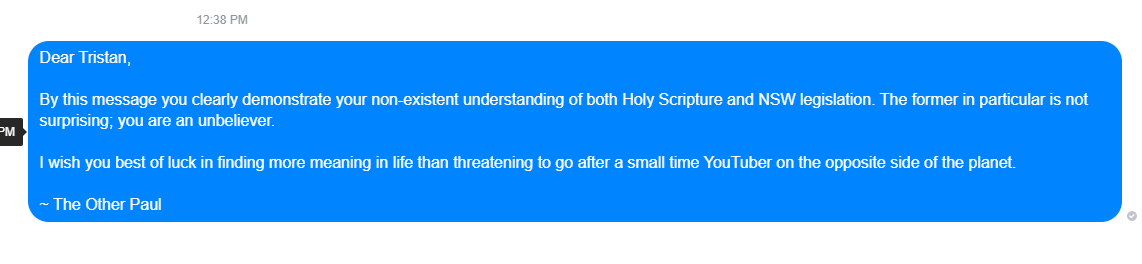
But there is one final episode to this saga. Tristan soon private messaged me after our comments exchange:


My response in two parts:

1: *WHEEEEEEEEEEEEEZE*

2: 

P.S. I couldn't find Tristan's comments a few days after they were posted. Perhaps he deleted them; take that as you will.

~~~

I - Tristan Kapp interview: https://pdby.co.za/sasc-rev-kapp-interview/

II - Response to first comment:


III - Response to second comment:


Monday, January 25, 2021

I won't apologise for my heritage


Just a quick post, not too flashy:

Happy Australia Day, no qualifications. No "this is a time to mourn", no "we weren't a perfect nation". Happy Australia Day. 

Australian Christian figures and media organisations will nowadays often qualify Australia Day with some reminder to lament the suffering of the indigenous. Motivated by a defeatist, self-hating version of Christianity, they suck any joy and pride out of the day, as if our nation isn't worthy of any celebration. Eternity news here is a good example. Granted, this is reporting on a Church's action, not giving an opinion piece. However, you quickly learn with media orgs like Eternity that what they do and do not report on is a good test of their demeanour. Notice how this is virtually the only article on their site pertaining to Australia Day, and it shows a Church trying to play the middle ground, neither condemning or 'whitewashing' Australia's history. They - Eternity - can't bring themselves to promote joyous celebration on this day; we can't enthusiastically celebrate our nation's founding. This is why Christian centrists and pacifists rile me up.

There are also the usual hordes gathering around for their "Invasion Day" protests, with Australia's media oligarchs fuelling their garbage [I]. These people don't care about debate, they don't care about sober historical research. They hear "white man bad" and bang the war drums.

First we need to see the ideological assumptions of this pack. Assuming the black armband view of history [II] is true, British colonies have historically and brutally mistreated indigenous Australians, and only in recent decades has this begun to be rectified. Therefore, we should not celebrate Australia as some great achievement of civilization, but a nation built on the blood of murdered natives and their destroyed societies. Instead we should mourn this destruction, apologise to the natives, and do everything in our power to raise them up in well-being 

That's the gist of their view, and I aimed to be charitable in presenting it. But however well I word it, I can't escape how rubbish the logic is.

If a bloody history disqualifies a nation from retaining any pride, then no people on earth can have pride in their nation. But the activists may be more than happy for this to be the case, at least for white Europeans; rootless urban parasites have no interest in the pride or even the survival of their heritage. Yet they're all for minorities having pride in their heritage, no matter how barbaric that heritage is, such as traditional indigenous culture [III]. And I mean that without qualification and without malice; the 'noble savage' is a myth, and indigenous Australian culture was the dictionary definition of barbaric. See the article in footnote three. But also take time to read arguably the most in depth account of pre-colonial indigenous culture, The Life and Adventures of William Buckley [IV], in which a former convict recounts his experience of living with the Wathaurong people for 32 years, including the bloody warfare and barbaric treatment of their own kin (especially women). Don't take these sources as the be-all-end-all, but as a good start on this inconvenient topic. 

So, are activists prepared to start condemning indigenous Australians for their racial pride? When will they start demanding that National Sorry Day become National Say-Sorry-to-Your-Women Day?

But this is even assuming that the black armband view is true, even partially so. One of a handful of historians to dare to combat this orthodoxy is Keith Windschuttle in his multi-volume "The Fabrication of Aboriginal History", in which he thoroughly critiques many claims of deliberate killings and genocide of indigenous Australians. Often, he is very successful, but other times not, as countless online critiques of his work emphasise (although they too sometimes misrepresent Windschuttle). When half the academic establishment rushes to attack your work, it's inevitable that genuine errors will be found. And all this to say, read Windschuttle, read the primary sources he cites, read his opponents, and read Windschuttle again to see if they accurately represent him. Don't rely on organisations like the ABC and activist NGOs who have a vested interest in lying about history. You will see that the black armband view is at best simplistic or at worst a lie.

In the end, whatever history says, the result of colonisation is clear; a great and prosperous civilization which even many indigenous persons have come to benefit from, most of all from being exposed to the Gospel, and having access to countless opportunities for personal fulfilment and material comfort (especially compared to their former way of living). For this I won't apologise.

We can debate the mistakes the British made every day of the year in the blogosphere and the halls of academia. But this one day especially deserves to be one of unqualified celebration. A civilization was born, and the greatest cultural achievements this continent has ever seen were achieved in the last 200 years. But the most importantly, a new front for the Gospel was opened.

No, you rootless urban parasite. I won't shun my heritage; I won't be guilted into shaming my ancestors; I won't kiss the feet of an aboriginal as if I did something wrong; I won't be lamenting today, but joyous. If indigenous people want to lament any sufferings they incurred, they can go ahead, but neither they nor any white saviour activists will stop me from thanking the Lord for forming this great nation.

I will praise the rise of civilization and laugh at the cry of activists.

Happy Australia Day.

~~~

I - For example, The Sydney Morning Herald: https://www.smh.com.au/national/on-invasion-day-our-calls-for-justice-will-not-be-silenced-20210124-p56wf0.html

II - An activist-led school of historical thought whereby post-colonial Australia was overall disgraceful in its treatment of indigenous Australians. An overview of the debate can be read here: 
https://www.aph.gov.au/About_Parliament/Parliamentary_Departments/Parliamentary_Library/pubs/rp/RP9798/98RP05#CON

III - Part II of a series of articles, all of which should be read (though the links in this article are broken, so you will need to manually search for them):
https://quadrant.org.au/opinion/bennelong-papers/2013/05/the-long-bloody-history-of-aboriginal-violence/

IV - Full PDF here:
https://openresearch-repository.anu.edu.au/bitstream/1885/115045/2/b12742697.pdf

Monday, December 28, 2020

Cool Classical Quotes - The Lord and His Armies at the Siege of Jerusalem?

Two cornerstone historians of antiquity - Cornelius Tacitus and Titus Flavius Josephus (aka Yosef ben Matityahu) - record some fascinating supernatural events from before and during the Siege of Jerusalem (A.D. 70). Both lived in the 1st century A.D. and wrote shortly after the event (Tacitus in the early 100s, Josephus less than a decade after the event), making their joint testimony highly significant.

Tuesday, November 24, 2020

Seams in the Seamless Garment

Of all the post-enlightenment heresies to afflict the Church, Seamless Garment "theology" is among the most pathetic. Its' one thing for an idea to be heresy; its wrong and must be crushed. But its' special when a hersy is just... weak. As in, the very meat of the heresy only stands with a backbone of gelatin. This is the case with Seamless Garment "theology" in two ways.

BUT FIRST, I'll define this belief for those who don't know of it (by name, at least). National Catholic Register - a Catholic news/opinion site that very much supports it - defines the Seamless Garment as follows:

The Church proposes what is called a “consistent ethic of life”.  It must, of course, do so because it is bound by sacred tradition to the proposition that all human beings, without any exception whatsoever, are made in the image and likeness of God and that Jesus Christ died for all human beings, without any exception whatsoever.  Therefore each human person—without any exception whatsoever—is sacred and is the only creature that God wills for its own sake. [I]

Like many heresies, this doesn't sound all too bad, and it even sounds orthodox. But also like many heresies, the Devil is (literally) in the details. The last sentence, that "each human person - without any exception whatsoever - is sacred..." is applied to mean that the death penalty is not to be exercised except for when it is absolutely necessary for the physical protection of the community. This is more or less a softer version of the argument, made popular by Pope John Paul II (JPII), who coined the "Seamless Garment" ethic. But it has grown more aggressively anti-death penalty since the article was published (2014). In 2017, Pope Francis made a change to catechism 2267, the section on the death penalty. The reading replaced by Francis was itself a replacement by JPII that established the Seamless Garment foothold on the death penalty, saying:

Assuming that the guilty party's identity and responsibility have been fully determined, the traditional teaching of the Church does not exclude recourse to the death penalty, if this is the only possible way of effectively defending human lives against the unjust aggressor.

If, however, non-lethal means are sufficient to defend and protect people's safety from the aggressor, authority will limit itself to such means, as these are more in keeping with the concrete conditions of the common good and more in conformity to the dignity of the human person.

Today, in fact, as a consequence of the possibilities which the state has for effectively preventing crime, by rendering one who has committed an offense incapable of doing harm - without definitely taking away from him the possibility of redeeming himself - the cases in which the execution of the offender is an absolute necessity "are very rare, if not practically nonexistent." [II]

Again, this itself is a revision of the earlier teaching, specifically from the 16th century Catechism of the Council of Trent, which affirmed a straightforward right of the state to execute murderers, going as far as to say that such is "an act of paramount obedience to this Commandment which prohibits murder." [III]

But according to Francis, JPII's garment wasn't so seamless. So he felt the need to revise it once again, strengthening the immorality of the death penalty in absolute terms:

Recourse to the death penalty on the part of legitimate authority, following a fair trial, was long considered an appropriate response to the gravity of certain crimes and an acceptable, albeit extreme, means of safeguarding the common good.
Today, however, there is an increasing awareness that the dignity of the person is not lost even after the commission of very serious crimes. In addition, a new understanding has emerged of the significance of penal sanctions imposed by the state. Lastly, more effective systems of detention have been developed, which ensure the due protection of citizens but, at the same time, do not definitively deprive the guilty of the possibility of redemption.Consequently, the Church teaches, in the light of the Gospel, that “the death penalty is inadmissible because it is an attack on the inviolability and dignity of the person”, and she works with determination for its abolition worldwide. [IV]

Francis clearly had in mind a more blunt moral condemnation of the death penalty, otherwise he wouldn't have felt a need to revise JPII's revision. The second half in particular makes the immorality of the death penalty more explicit, and Francis makes obvious what JPII made implicit, that use of the death penalty as a societal defence is no longer necessary.

So now you should have a decent idea of the Seamless Garment case against the death penalty. Now we will see why I titled this post "Seams in the Seamless Garment".

A Thorn in Rome's Side - Scripture

Unfortunately for Francis et al, there is one passage of scripture that is particularly damning of Seamless Garment ethics, that being Genesis 9:5 - 6:

וְאַךְ אֶת-דִּמְכֶם לְנַפְשֹׁתֵיכֶם אֶדְרֹשׁ, מִיַּד כָּל-חַיָּה אֶדְרְשֶׁנּוּ; וּמִיַּד הָאָדָם, מִיַּד אִישׁ אָחִיו--אֶדְרֹשׁ, אֶת-נֶפֶשׁ הָאָדָם
שֹׁפֵךְ דַּם הָאָדָם, בָּאָדָם דָּמוֹ יִשָּׁפֵךְ: כִּי בְּצֶלֶם אֱלֹהִים, עָשָׂה אֶת-הָאָדָם

And even your blood for your lives I will require, from the hand of every living thing I will require it. And from the hand of man, from the hand of a man's brother, I will require the life of man.

Whosoever sheds the blood of man, by man shall his blood be shed. For in His image did God make man.

A very clear command in verse 5, followed by a pretty based chiasm [V] in verse 6. And I can attest to it being just as clear in the Hebrew (and the Septuagint Greek [VI]) as it is in English versions. It is important to include verse 5 as well because most tend to only debate verse 6, being the clearer (and cooler) portion of the passage. And this is how some scholars can argue that God didn't give a "command" to execute murderers per say, but gave some vague poetic saying emphasizing the seriousness of murder. Of course, when we include verse 5, we have a very clear, non-poetic command. The incredibly fundamental nature of the command must also be mentioned. First, this is a command given to all of post-flood mankind before the larger body of statutes were given to Moses. Second, it is presented just after God gave the extremely basic and universal right to eat meat. Death for murderers appears as normative as eating meat.

So what issue does this pose for the Seamless Garment? Most obviously, it denies the very premise that because all humans are made in the image of God, all killing is wrong unless it is practically necessary at specific moments and time periods for the safety of the community. But here, the scriptures not only prescribe death for such practical situations, but for spiritual and moral reasons too, as shown in Genesis 9:6b. Now, citing various crimes that warranted death in the legal codes of Israel would open up a separate "but Christ abolished the Law!" tangent . Silly and unbiblical as that opinion is, we can cut this all out by appealing to a command so fundamental that it was given beside the right to merely eat meat.

So, like many Roman doctrines, the scriptures present a major defeater to the Seamless Garment. But in like fashion, Roman apologists have interpretive wands stuffed up their sleeves for situations just like this.

One of easiest and more common magic tricks they employ is scholarly obfuscation. That is, dump a dozen quotes from scholars who disagree on a passage's interpretation, and then declare (if only implicitly) that because some scholars are in disagreement on interpretation, any argument for a definitive interpretation should be disregarded. This is how Roman apologist David Armstrong responds to the passage, in his own response [VII] to Edward Feser's use of Genesis 9:5 - 6 in his excellent book "By Man Shall His Blood Be Shed: A Catholic Defense of Capital Punishment". Rather than actually address Feser's arguments for the historical, mainstream interpretation of the passage (David himself admits he doesn't intend to argue interpretation), he just quote dumps a bunch of scholars who say "this means X" or "there is disagreement". That's it. He just shrugs and says "Well scholars X and Y think Genesis 9:6 is proverbial, not binding".

Without giving even a minor argument for why we should believe their claims (again, intentional on David's part), he turns around and says that these interpretations that avoid supporting the death penalty are "possible" and "plausible". But why? Why should I believe these are even "possible" or "plausible", let alone true? I, and Feser, don't care about what's theoretically possible, but what actually is. That is, don't obfuscate with a thousand opinions ala the Talmud, but give us answers. Until you give us an actual argument that demonstrates a better interpretation for the passage, then I see no reason to dump my current, well-argued position.

Armstrong does more than what many Roman apologists do and actually addresses the elephant that is Genesis 9:5 - 6. I've argued about the death penalty on a couple of occasions with my traditionalist Catholic friends trying to defend this Seamless Garment teaching, and when I raised Genesis 9:5 - 6, both times they didn't know of the passage and were either stumped or had to gish gallop around it.

I could write more on this, but I don't think it is necessary, and this was only meant to be a short writeup. A basic knowledge of scripture is enough to refute many heresies, including the Seamless Garment. And in a massive show of irony, God's command in Genesis 9 proves that death for murder actually values life even more so than the Seamless Garment position. That one must be put to death for killing even a lowly peasant shows how valuable life is, how ultimate its value is. It has always been a basic assumption of law that the more severe a crime, the more severe the punishment. This is why assault gives you more jail time than petty theft, or rape more than public defecation. How much more valuable must life be that to take it warrants death, the ultimate punishment?

~~~

I - Seamless Garment article, by Mark Shea
https://www.ncregister.com/blog/the-seamless-garment-what-it-is-and-isn-t

II - JPII's catechism (death penalty: 2267)
http://www.vatican.va/archive/ccc_css/archive/catechism/p3s2c2a5.htm

III - Catechism of the Council of Trent, the Fifth Commandment
http://www.catholicsociety.com/documents/Catechism_of_the_Council%20of_Trent.pdf

IV - Francis's 2017 revision to Catechism 2267
http://www.vatican.va/roman_curia/congregations/cfaith/documents/rc_con_cfaith_doc_20180801_catechismo-penadimorte_en.html

V - "A chiasm (also called a chiasmus) is a literary device in which a sequence of ideas is presented and then repeated in reverse order."
https://www.gotquestions.org/chiasm-chiastic.html

VI - καὶ γὰρ τὸ ὑμέτερον αἷμα τῶν ψυχῶν ὑμῶν ἐκζητήσω, ἐκ χειρὸς πάντων τῶν θηρίων ἐκζητήσω αὐτὸ καὶ ἐκ χειρὸς ἀνθρώπου ἀδελφοῦ ἐκζητήσω τὴν ψυχὴν τοῦ ἀνθρώπου. 

ὁ ἐκχέων αἷμα ἀνθρώπου ἀντὶ τοῦ αἵματος αὐτοῦ ἐκχυθήσεται, ὅτι ἐν εἰκόνι θεοῦ ἐποίησα τὸν ἄνθρωπον.

VII - Armstrong's article
https://www.patheos.com/blogs/davearmstrong/2017/12/genesis-96-capital-punishment-contra-ed-feser.html

Friday, October 9, 2020

Cool Classical Quotes - Paul and Peter's Martyrdom AND GRAVESTONES

"Thus Nero, publicly announcing himself as the chief enemy of God, was led on in his fury to slaughter the apostles. Paul is therefore said to have been beheaded at Rome and Peter to have been crucified under him. And this account is confirmed by the fact that the names of Peter and Paul still remain in the cemeteries of that city even to this day. But likewise, a certain ecclesiastical writer, Caius by name, who was born about the time of Zephyrinus, bishop of Rome, disputing with Proclus, the leader of the Phrygian sect, gave the following statement respecting the places where the earthly tabernacles of the aforesaid apostles are laid: 

"I can show," said he, "the trophies of the apostles. For if you will go to the Vatican, or to the Ostian road, you will find the trophies of those who have laid the foundation of this church. And that both suffered martyrdom about the same time, Dionysius, bishop of Corinth, bears the following testimony, in his discourse addressed to the Romans. 'Thus, likewise you, by means of this admonition, have mingled the flourishing seed that had been planted by Peter and Paul at Rome and Corinth. For both of these having planted us at Corinth, likewise instructed us; and having in like manner taught in Italy, they suffered martyrdom about the same time.'"

This testimony I have added in order that the truth of the history might be still more confirmed."

~ Eusebius of Caesaria, Ecclesiastical History. Book II, Chapter 25, Sections 5 - 8. [I]

Greek Text

Ταύτῃ γοῦν οὗτος, θεομάχος ἐν τοῖς μάλιστα πρῶτος ἀνακηρυχθείς, ἐπὶ τὰς κατὰ τῶν ἀποστόλων ἐπήρθη σφαγάς. Παῦλος δὴ οὖν ἐπ̓ αὐτῆς Ῥώμης τὴν κεφαλὴν ἀποτμηθῆναι καὶ Πέτρος ὡσαύτως ἀνασκολοπισθῆναι κατ̓ αὐτὸν ἱστοροῦνται, καὶ πιστοῦταί γε τὴν ἱστορίαν ἡ Πέτρου καὶ Παύλου εἰς δεῦρο κρατήσασα ἐπὶ τῶν αὐτόθι κοιμητηρίων πρόσρησις, οὐδὲν δὲ ἧττον καὶ ἐκκλησιαστικὸς ἀνήρ, Γάϊος ὄνομα, κατὰ Ζεφυρῖνον Ῥωμαίων γεγονὼς ἐπίσκοπον: ὃς δὴ Πρόκλῳ τῆς κατὰ Φρύγας προϊσταμένῳ γνώμης ἐγγράφως διαλεχθείς, αὐτὰ δὴ ταῦτα περὶ τῶν τόπων, ἔνθα τῶν εἰρημένων ἀποστόλων τὰ ἱερὰ σκηνώματα κατατέθειται, φησίν: 

‘Ἐγὼ δὲ τὰ τρόπαια τῶν ἀποστόλων ἔχω δεῖξαι. ἐὰν γὰρ θελήσῃς ἀπελθεῖν ἐπὶ τὸν Βασικανὸν ἢ ἐπὶ τὴν ὁδὸν τὴν Ὠστίαν, εὑρήσεις τὰ τρόπαια τῶν ταύτην ἱδρυσαμένων τὴν ἐκκλησίαν. Ὡς δὲ κατὰ τὸν αὐτὸν ἄμφω καιρὸν ἐμαρτύρησαν, Κορινθίων ἐπίσκοπος Διονύσιος ἐγγράφως Ῥωμαίοις ὁμιλῶν, ὧδε παρίστησιν ‘ταῦτα καὶ ὑμεῖς διὰ τῆς τοσαύτης νουθεσίας τὴν ἀπὸ Πέτρου καὶ Παύλου φυτείαν γενηθεῖσαν Ῥωμαίων τε καὶ Κορινθίων συνεκεράσατε. καὶ γὰρ ἄμφω καὶ εἰς τὴν ἡμετέραν Κόρινθον φυτεύσαντες ἡμᾶς ὁμοίως ἐδίδαξαν, ὁμοίως δὲ καὶ εἰς τὴν Ἰταλίαν ὁμόσε διδάξαντες ἐμαρτύρησαν κατὰ τὸν αὐτὸν καιρόν.’’ 

Καὶ ταῦτα δέ, ὡς ἂν ἔτι μᾶλλον πιστωθείη τὰ τῆς ἱστορίας. [II]

~~~

I - Translation used:
Eusebius' Ecclesiastical History Complete and Unabridged. New Updated Edition, Hendrickson Publishers, 2018. Book II, Chapter 25, Sections 5 - 8; pg. 63.
I would have translated it myself but it's a big passage and my time is limited these days. I also added a few commas in the English for smoother reading (one after Nero, another after Dionysius, and another after Corinth in "bishop of Corinth).

II - Greek text from Perseus Digital Library
Link to Section 5 (other sections/chapters/books can be viewed through divisions at the top of the page): 
http://www.perseus.tufts.edu/hopper/text?doc=Perseus%3Atext%3A2008.01.0640%3Abook%3D2%3Achapter%3D25%3Asection%3D5
Greek sections were reformatted in order to make a coherent single passage.

Wednesday, October 7, 2020

Infallibility - a canon without ammo

Good blogs have regular smaller posts with brief arguments and conversation starters, not necessarily flooded with footnotes. So, expect more like this on the regular, every week.

It's popular among many lay and some professional Catholic apologists to argue that Papal/Magisterial Infallibility is more likely or even necessary because such is needed to gain absolute doctrinal certainty, and thus prevent the constant splits of Protestant denominations. Often this is said only with respect to more 'obscure' passages, but other times it is said for all scriptures. My response will be relevant to both.

Now, maybe, MAYBE the Catholic would have a point, if the Roman Catholic Church had an infallibly proclaimed edition, translation, and commentary of the scriptures. Not merely approved, but infallibly so, since, after all, something must be infallible to be certain. So, do they? Well, no.

First, on not having an infallible edition. Don't mistake this for not having an infallibly proclaimed canon. They do, being declared by the Council of Trent; an Ecumenical Council, and so, according to Catholics, binding on the faithful, infallible. And if this declaration is infallible, then it simply can't be changed. And so far, they haven't, so first point goes to the RCC.

But there isn't an infallibly proclaimed edition of the Bible; that is, an exact version of the canonical texts. Protestant apologist TurretinFan has argued that Trent also defined a specific edition [I], which would basically demolish Magisterial infallibility, since we know now that the Vulgate has issues, and the RCC itself has revised its official Bible multiple times, eventually ditching the Vulgate altogether with the aptly named Nova Vulgata (New Vulgate) in 1979, which is basically Nestle-Aland 26 (a modern[ist] critical text) translated into Latin. However, Barrett Turner at Called to Communion has argued that the specific edition called for at Trent was done so as a "juridical" and non-infallible measure [II]. Having read his sources and while still reading the full sources from Trent, I lean towards Barrett's conclusion, although I see potential defeaters that may, in fact, prove an "infallibly" proclaimed edition, and by extension, an error by an allegedly infallible council. So far, however, I believe the RCC has not taken an infallible stance on an exact text of the scriptures.

But that right there is a problem, at least for the "we need infallibility" argument. If the Church can't even infallibly decide on the very text of the scriptures themselves, what use are they to infallibly decide on the peculiarities of interpreting scripture? How can they even be trusted to make infallible decisions on the very thing they can't infallibly define with exactitude?

And these aren't just quibbles on spelling or syntax differences; entire Gospel accounts like Mark's resurrection account (Mk. 16:9 - 20) and the incident of the adulteress (known as the Pericope Adulterae, Jn. 7:53 - 8:11) live or die depending on your text critical opinions, among many other differences that change the meanings of many passages. Entire doctrines are affected depending on your manuscript philosophy, both in the Old and the New Testament (for the often under-appreciated doctrinal significance of textual variants in the NT, I highly recommend a perusal of Pastor James Snapp Jr.'s blog [III]. He is - in my and some others' opinions - the smartest and most thorough text critic alive).

But arguably worse than no infallibly-approved text base is the lack of infallibly-approved translation or commentary. A translation is effectively a mini-commentary on the scriptures, since you have to make doctrinally significant judgement calls at many, many points. For example, does αὐθεντέω in 1 Timothy 2:12 [IV] mean "to exercise authority", or "to take authority", or "to domineer", or any number of other suggested translations? The sense you choose for the word - neutral or negative connotation, ingressive or non-ingressive sense - decides whether the passage condemns women pastors or merely the abuse of leadership by women (among other interpretations). And I know from experience that this passage is a go-to prooftext for traditional Catholics in opposing female priests, so this is no small matter. And this is the case for countless other words and passages.

Then you still need a commentary proper. Both before and after translation, many passages need further explanation. By and large, most interdenominational debates occur on this level, even more than translation debates in my experience (although they often occur hand in hand). Among the most obvious examples would be Romans 8 - 9; are all people pre-destined to salvation and damnation? Or is Paul just emphasising God's sovereignty but without contradicting human will in accepting salvation? 

So, where is the infallibly proclaimed commentary on scriptures? Where can I go to get a definitive, unequivocal answer to the many debated passages like Romans 8 - 9? I know of a few Catholic Study Bibles, but none with a Papal Bull printed in the underside, let alone one with "Ex Cathedra" stamped on the edge.

All of this to say; what is the use of infallibility? You (allegedly) have absolute certainty on a small handful of issues and passages. Fantastic, how about the rest? Where are the infallible interpretations on the countless passages that helped create the "FoUrTy ThOuSaNd" denominations you beat us over the head with? Finally, what is your infallibility doing about the modernist scourge in your Church? And outright heretics (even by Protestant standards) like "Father" James Martin? Where was your infallibility when Christendom split in half in 1054, and when your remnant split again in the 16th century?

Papal infallibility is, in the end, a canon (pun intended) without ammo. But if not infallibility, then what? How can we maintain certainty without an infallible guide? We use our eyes, ears, and brains, as God assumed Israel would when he gave Moses the Law, without any infallible interpreter beyond direct, one-off prophetic revelations, and only at rare intervals at that. And when Israel strayed on multiple occasions, including in the NT period, did God finally say "right, thats it, you need a Pope"? No, he said "Read your Bible" , and do so at the expense of a contradicting magisterium (Matt. 15:1 - 9). Will there be disagreement on interpretation? Yes. So what do we do? We do what Christ, Paul, the Apostles, and the Church Fathers did; we investigate the scriptures for the correct interpretation.

Don't let Catholic apologists make obscure what God made for clarity.

~~~

I - TurretinFan, Calvin, Trent, and the Vulgate: Responding to Barrett Turner. 
https://turretinfan.blogspot.com/2011/06/calvin-trent-and-vulgate-responding-to.html

II - Barrett Turner, Calvin, Trent, and the Vulgate: Misinterpreting the Fourth Session. 
https://www.calledtocommunion.com/2011/06/calvin-trent-and-the-vulgate-misinterpreting-the-fourth-session/

III - http://www.thetextofthegospels.com/

IV - "But I am not permitting a woman to teach, nor to exercise authority upon a man."